Rosen Method Bodywork
Where the muscle lets go, the feeling can come home.
Rosen Method is a gentle, non-intrusive form of touch and verbal awareness that works with the relationship between chronic muscle tension and the feelings we hold out of awareness. Rather than working on the body, I listen through my hands — resting unhurried attention on areas of habitual holding and following the small changes in breath and muscle as they begin to relax. As a muscle genuinely lets go, what it was holding — a feeling, a memory, a long-guarded truth — can rise gently into awareness.
The method was developed by Marion Rosen (1914–2012), a German-born physical therapist who, over decades of clinical practice, noticed that patients who could feel and speak what troubled them relaxed and recovered more fully than those who could not. Rosen described the aim not as fixing something broken but as an unfolding toward a person's own vitality — a transformation, in her words, "from the person we think we are to the person we really are."
What a session is like
Quiet and slow. You rest comfortably on a table, lightly draped, while I follow your breath and your body's small responses. The pace is set entirely by what the body is ready to release — nothing is forced, and there is nothing you need to do but notice.
What it is — and isn't
- The touch listens rather than pushes — no deep pressure, no working of knots, no correction imposed from the outside
- Simple verbal reflections invite you to notice what you feel, so physical and emotional awareness can meet
- Not massage, not manipulation, not a technique aimed at a fixed outcome
- Not a medical treatment — it makes no claim to diagnose or cure, and complements rather than replaces medical or mental-health care
Somatic Experiencing®
Trusting the body's own innate movement toward healing.
Somatic Experiencing (SE) is a gentle, body-oriented approach to working with stress and trauma, developed by Peter A. Levine, PhD, and introduced in his 1997 book Waking the Tiger. Rather than asking you to recount a difficult story in detail, SE works slowly with the body's present-moment experience — the "felt sense," a term SE borrows from Eugene Gendlin's Focusing work — so the nervous system can settle at a pace it can tolerate.
It rests on a simple observation: animals in the wild naturally discharge the intense energy of a survival response, and in humans this response can remain incomplete and held in the body. Much of what we experience as anxiety, tension, or overwhelm is the nervous system still carrying a charge it never got to complete.
How the work moves
- Works in small, careful steps (titration) and gentle movement between activation and calm (pendulation) — always within your window of tolerance
- Attends to sensation, breath, and subtle impulse, letting held survival energy complete and release rather than reliving the event
- Grounded in a growing, if still limited, evidence base — including a 2017 randomized controlled trial showing benefit for PTSD symptoms
- A supportive, non-pathologizing way to help the body find its own return to ease — offered alongside, not in place of, medical or psychological care
Contemplative Practice
Meeting whatever arises with steady, compassionate presence.
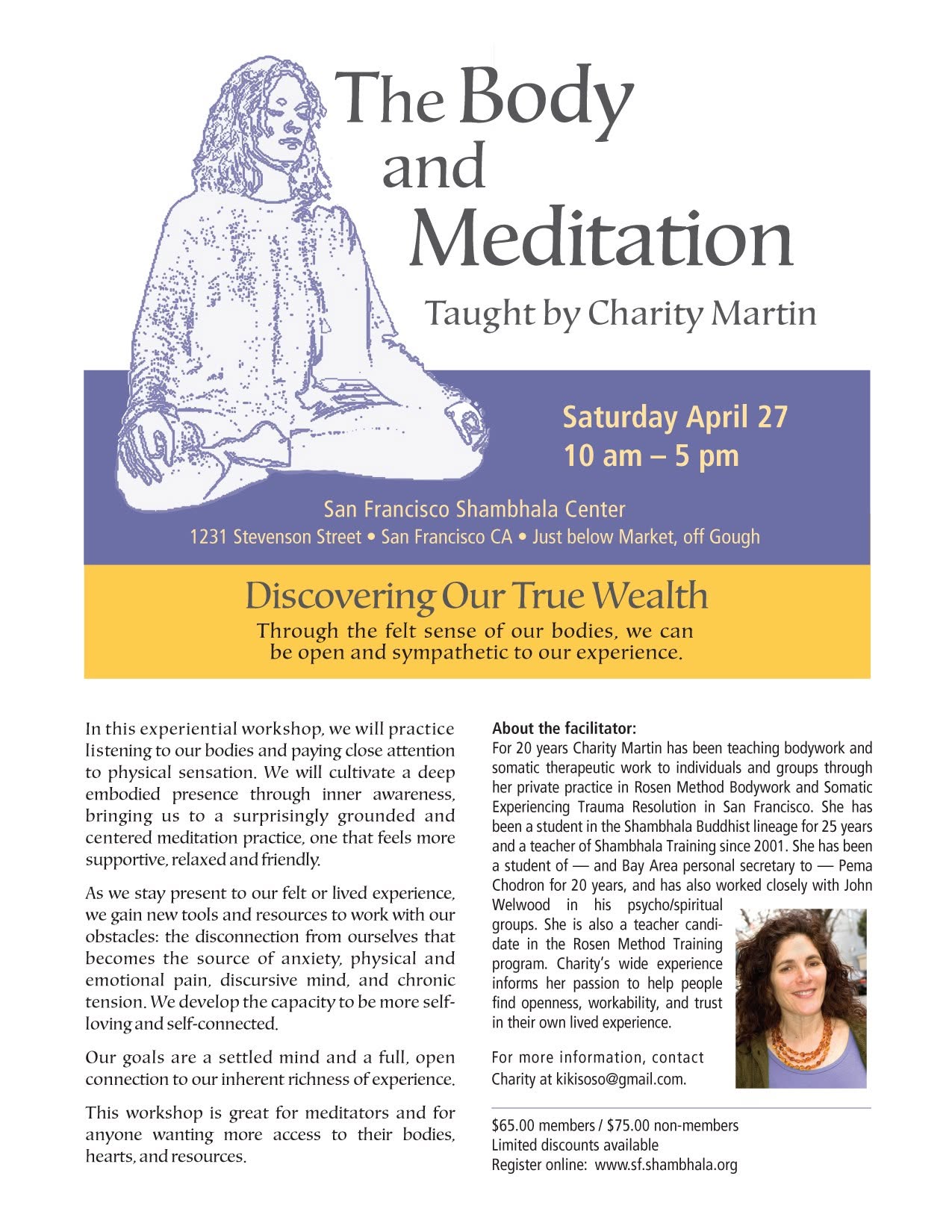
My work is grounded in the Shambhala Buddhist tradition — a Western contemplative path derived from Tibetan Buddhism, founded by Chögyam Trungpa Rinpoche, who came to the West in 1970. Its teachings hold that every person carries an innate basic goodness and can meet life with fearlessness — not the absence of fear, but the willingness to lean into difficulty with gentleness and clarity. This is "meditation in action": awareness cultivated in stillness, then carried into the body, relationships, and the work of the hands.
I have been a longtime Shambhala student and teacher, and served as Pema Chödrön's Bay Area personal secretary for twenty years. Her teachings — on staying present with pain and uncertainty, on self-compassion, on softening rather than bracing — translate directly into the bodywork: unhurried present-moment attention, and the capacity to stay with discomfort without recoiling.
- Present-moment attention that stays with discomfort without recoiling
- Sitting meditation, basic goodness, and fearlessness, carried off the cushion into everyday life and the body
- Decades of contemplative training brought to every session
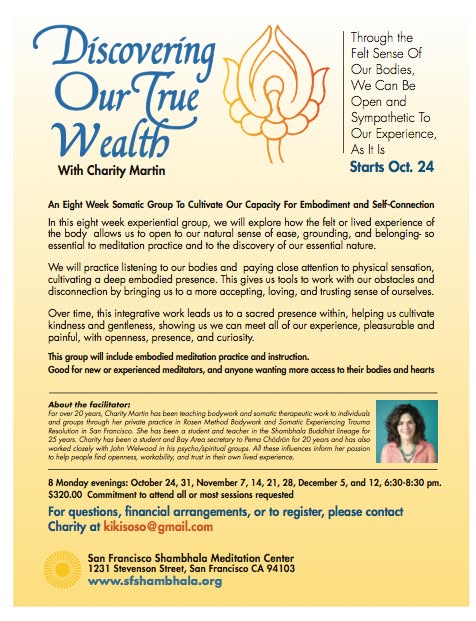
- Offered one-to-one and in eight-week embodiment groups
Rosen Method Bodywork® and Somatic Experiencing® are registered practices with their own training institutes. The descriptions here are offered for understanding, not as medical or psychological advice.